
Mastering Temperature Control How to Optimize Heat Exchanger Efficiency with Three-Way Valves
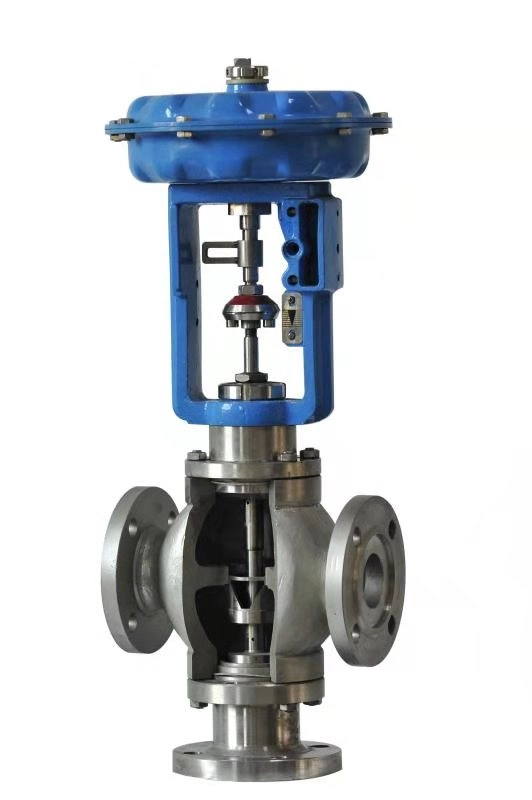
Walk into a chemical plant’s utility room on a Monday morning. The heat exchanger feeding the reactor loop is running 8°C hotter than setpoint. Operators tweak the cooling water flow manually, but it swings, wasting steam on one side and risking product quality on the other. Sound familiar? In HVAC systems, district heating networks, or process plants, inconsistent outlet temperature from heat exchangers eats energy, spikes utility bills, and forces extra maintenance. That’s where a solid three-way valve steps in as the go-to tool for mixing valve application—blending hot and cold streams precisely so the exchanger delivers exactly what the process needs.
Three-way globe control valves handle this job better than most alternatives. They mix two fluids (hot and cold) into one outlet stream or divert flow between paths, giving tight temperature regulation without the pressure drops or complexity of separate two-way valves. Done right, you can shave 10–20% off heating/cooling energy use while keeping temperatures rock-steady. This piece breaks down how to pick and apply them in real-world heat exchanger setups.
Why Temperature Swings Hurt Heat Exchanger Performance
Heat exchangers thrive on steady inlet conditions. When the mixed medium temperature drifts—even by a few degrees—overall heat transfer coefficient drops. Fouling accelerates because you’re pushing harder to make up the difference. In a typical shell-and-tube exchanger handling process heating, every 1°C deviation in mixed water temperature can cut efficiency by 1–2%, according to field data from refinery utilities.
Common pain points engineers fight:
- Overshooting during load changes (startup, demand spikes)
- Hunting in the control loop from oversized valves or poor characteristics
- Energy waste when excess hot fluid bypasses or cold fluid overcools
- Uneven distribution in parallel exchanger banks
A three-way mixing valve sits upstream of the exchanger, blending return line fluid with supply to hit the exact target. Diverting types work downstream in bypass setups, but mixing configurations dominate for precise temperature control in most industrial loops.
Mixing vs. Diverting: Picking the Right Three-Way Valve Type
Three-way globe valves come in two main flavors—mixing and diverting. Get this wrong, and you’ll fight instability or poor rangeability.
- Mixing type: Two inlets (hot and cold), one outlet. The plug modulates to blend flows. Best for controlling exchanger inlet temperature directly. Handles larger pressure differentials and bigger sizes (over 4″) without excessive wear.
- Diverting type: One inlet, two outlets. Splits flow between exchanger and bypass. Useful in systems where you want to maintain constant flow through the pump while varying exchanger load.
In practice, mixing valves often double as diverting when delta-P is low and sizes stay modest. But for heat exchanger duty—where you need fine control over blended temperature—the mixing configuration usually wins. It keeps velocities reasonable and trim life long.
Here’s a quick decision table based on typical scenarios:
|
Application Scenario |
Preferred Type |
Why It Wins |
Typical Size Range |
|
Controlling heat exchanger inlet temp |
Mixing |
Precise blending, handles high delta-P |
1″–10″ |
|
Bypass control around exchanger |
Diverting |
Maintains constant total flow |
2″–8″ |
|
District heating return temp blending |
Mixing |
Tight control over supply to network |
4″–10″ |
|
Cooling water regulation in calenders |
Mixing |
Fast response to load changes |
2″–6″ |
Key Design Features That Make the Difference in the Field
Look beyond the nameplate. These details separate valves that last years from ones pulled during every turnaround.
- Flow path and characteristics: Equal percentage or linear plugs give the widest usable range. In mixing service, equal percentage helps maintain gain as flow splits change.
- Bonnet options: Standard for moderate temps, extended finned for hotter fluids (up to 425°C), bellows-sealed when zero emissions matter in chemical plants.
- Leakage class: Class IV (metal-to-metal) keeps tight shutoff for most loops; Class VI (soft seats) when bubble-tight is non-negotiable.
- Actuation: Pneumatic diaphragm with multi-spring setup responds quickest for temperature loops. Pair with a smart positioner for split-range control—common when blending steam and condensate returns.
- Materials and ratings: Bodies handle PN10–PN40 or Class 150–600. Temps from -29°C to +425°C cover steam, hot oil, and chilled water circuits.
Short switching times matter in dynamic systems like wire rod mill cooling. A sluggish valve lets temperature spike before correction, stressing the exchanger tubes.
Real-World Examples: Three-Way Valves in Action
Take a pulp mill’s black liquor heater. Hot liquor at 140°C mixes with cooler recycle to hit 105°C feed to the digester. A 6″ mixing three-way valve with pneumatic actuator and positioner holds ±1°C despite flow swings from 200 to 800 m³/h. Energy savings? Roughly 15% less steam demand after retrofit.
In a district heating plant, return water at 60°C blends with 120°C boiler supply to feed the network at 90°C. Diverting three-way valves on the bypass leg maintain constant pump flow while modulating exchanger duty—cut pumping power and boiler cycling.
HVAC engineers in large commercial buildings use similar setups for chilled water loops. Mixing valve upstream of air handlers keeps supply water steady at 7°C, improving coil performance and reducing chiller lift.
These aren’t lab results. They’re from plants where operators tracked kWh/ton before and after—double-digit savings when the valve actually controls instead of just being there.
Choosing and Sizing for Heat Exchanger Duty
- Define your loop: What’s the target outlet temperature? Max/min flows? Available delta-P?
- Calculate Cv needed at design conditions—remember density and viscosity change with temperature.
- Size for 70–80% open at normal load to keep good rangeability.
- Spec mixing type for most temperature control jobs unless bypass flow constancy is critical.
- Match actuator to fail position: air-to-open for fail-safe cooling, etc.
- Add positioner and accessories (volume booster for fast response, limit switches for interlocks).
Field tip: Always verify the valve’s installed characteristic matches the system curve. A linear trim on a system with square-root pressure drop gives nonlinear response—bad news for PID tuning.
Working with a Reliable Supplier for Valves, Actuators, and More
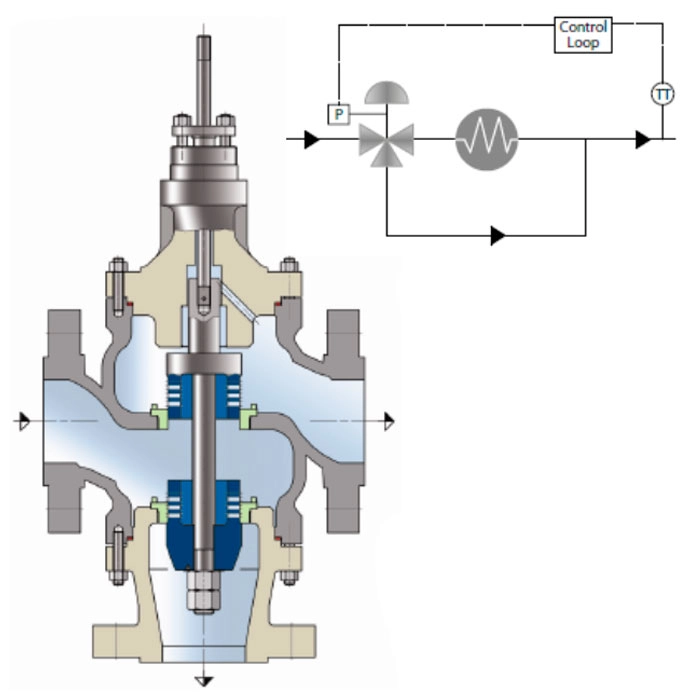
When you’re dealing with critical temperature loops, you want components that fit together without headaches. Miwival specializes in exactly that—one-stop source for control valves, actuators, and accessories. Their three-way globe control valves come in mixing and diverting styles, sized from 1″ to 10″, with pressure classes up to Class 600 and temperatures to 425°C. They pair pneumatic diaphragm actuators (multi-spring standard) with positioners and other add-ons so everything arrives matched and ready. Fast delivery, solid support, and a focus on durable, economical designs make them a practical choice for engineers who need reliability without overcomplicating the supply chain.
Conclusion
Getting heat exchanger efficiency right often boils down to rock-solid temperature control at the inlet. A well-chosen three-way globe valve in a mixing valve application does the heavy lifting—blending streams precisely, responding fast to changes, and cutting energy waste that adds up fast. Skip the shortcuts on sizing, trim selection, or actuation, and you’ll pay later in higher bills and shorter equipment life. Nail it, and the process runs smoother, costs drop, and those temperature alarms stay quiet. It’s straightforward engineering that delivers real payback.
FAQs
What’s the main advantage of a mixing valve application in heat exchanger systems?
It lets you blend hot and cold fluids right before the exchanger to hit a precise inlet temperature. That steady feed improves heat transfer, reduces fouling, and often cuts energy use by 10–20% compared to manual adjustments or two-way setups.
Should I pick a mixing or diverting three-way valve for controlling process temperature?
Go with mixing type for most cases where you’re adjusting the blended stream going into the exchanger. Diverting works better when you need to keep total flow constant through the pump while bypassing some around the exchanger.
How does a three-way valve help save energy in heating or cooling circuits?
By holding tight temperature control, it prevents over-heating or over-cooling. Less excess hot fluid means lower boiler or chiller load, and stable conditions reduce cycling—real plants see noticeable drops in steam or electricity consumption after proper installation.
What temperature range can these three-way globe control valves handle in typical industrial heat exchanger duty?
They cover -29°C to +425°C, which takes in chilled water, hot water/steam systems, thermal oils, and many chemical process loops. Extended finned bonnets help when fluids run hotter.
Any quick tips for sizing a three-way valve in a mixing valve application?
Calculate Cv at your normal operating point, aim for 70–80% open there, and pick equal percentage characteristic for best control range. Double-check pressure drop across the valve stays in the manufacturer’s sweet spot to avoid noise or erosion.


 consult
 WHATSAPP
 leave message
 top
top